

June 27th was PTSD Awareness Day in Canada - and if you work in insurance or legal claims, you already know that PTSD files have become some of the most contested, most scrutinized, and most frequently disputed in the portfolio.
That scrutiny isn't misplaced. PTSD is a real and serious diagnosis. But it's also one where the clinical picture is frequently more complicated than a single label can capture - and where a weak IME report doesn't just fail to help, it actively creates problems.
The question worth asking isn’t just “does this claimant have PTSD?” It’s “does this report actually answer that question in a way that will hold up?”
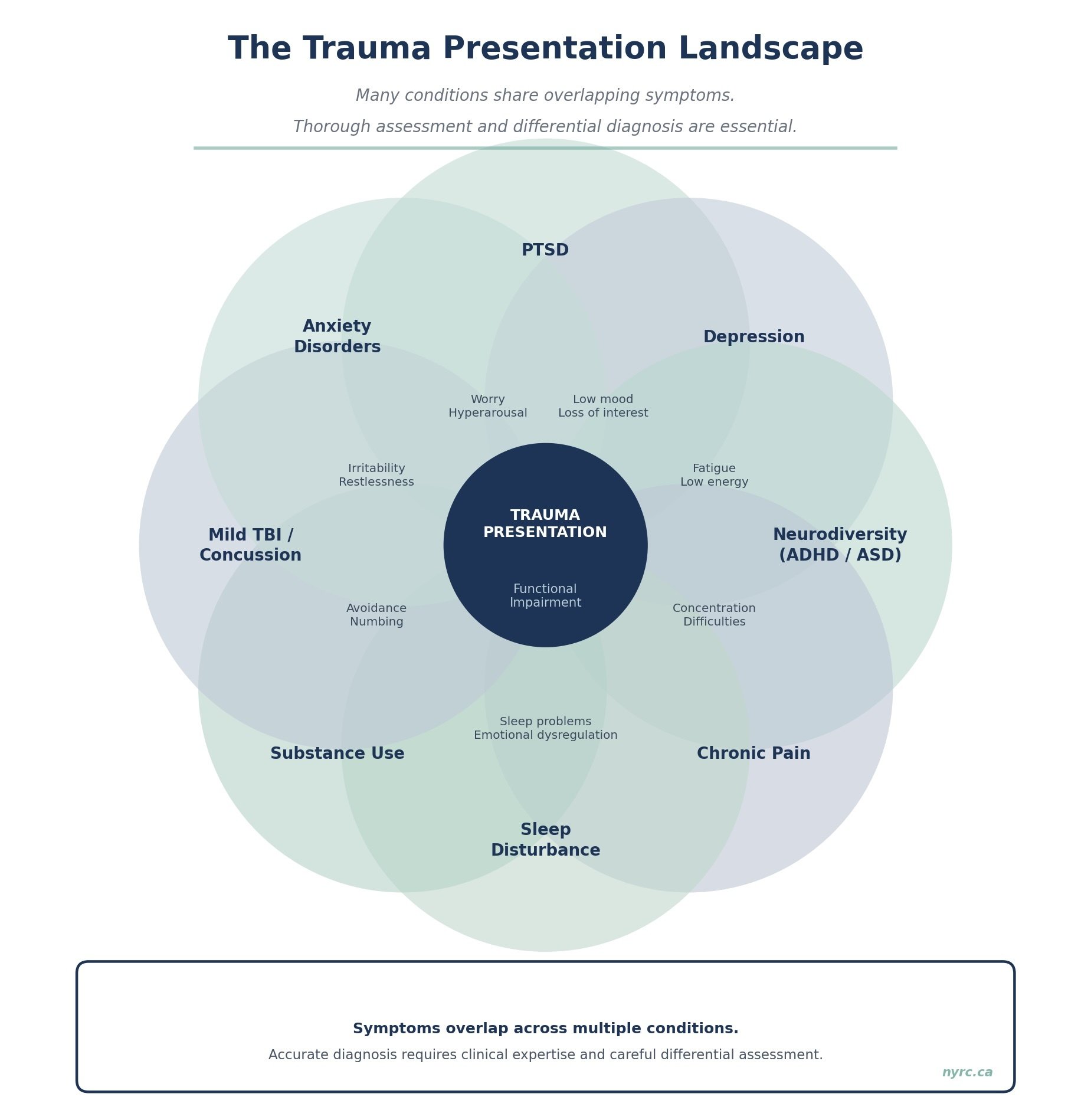
The Diagnostic Landscape Is More Crowded Than You’d Think
PTSD shares symptom territory with several related conditions - and distinguishing between them matters enormously for causation analysis, treatment planning, and report defensibility. Here’s what a thorough assessor should be weighing:
Adjustment disorder: a stress response that’s proportionate to the precipitant and typically resolves within six months. Very different prognosis and cost trajectory than PTSD.
Complex PTSD (CPTSD): a distinct presentation arising from prolonged or repeated trauma. Not captured in standard PTSD criteria, and with a meaningfully different treatment pathway.
Depression with trauma features: significant depressive illness where trauma is the trigger, not the defining pathology. The primary diagnosis changes the clinical picture substantially.
Anxiety disorders with trauma history: where a generalized or specific anxiety disorder co-exists with, but isn’t caused by, the index event.
These aren’t academic distinctions. They affect causation, prognosis, treatment cost, and how the report will read under cross-examination. If a PTSD IME report doesn’t address differential diagnosis explicitly and with clinical reasoning, it’s leaving the file exposed.
What to Look For in a Trauma Assessor
Trauma assessment is a specialized field, and the quality and depth of an assessment can significantly shape claim clarity, treatment direction, and report defensibility.
In complex trauma files, organizations should look for assessors with specific trauma experience and the ability to translate symptoms into functional impact and real-world impairment. A strong trauma assessor brings:
Proficiency with validated trauma-specific tools: PCL-5, CAPS-5, LEC-5
Experience with symptom validity and malingering assessment - because a defensible report needs to address effort and credibility
The clinical depth to distinguish PTSD from its diagnostic neighbours - not just describe symptoms
The ability to write clearly for a legal or insurance audience, without jargon, with methodology that can withstand scrutiny
Familiarity with overlapping presentations - including TBI, chronic pain, and substance use - conditions that frequently co-occur with PTSD and require differential expertise to disentangle
A functional lens for planning - the ability to connect psychiatric findings to RTW implications, treatment priorities, and accommodation recommendations, so the report serves not just diagnosis but next steps
The depth and quality of the assessment matters. In complex trauma files, a report that confirms a diagnosis without working through the differential - or without addressing overlapping conditions and functional implications - creates exactly the ambiguity that opposing experts will exploit.
Organizations that understand this invest in assessors who can do the full clinical work, not just the surface-level documentation.
"Working with individuals who may be experiencing PTSD, regardless of the underlying cause, requires sensitivity, experience, and a thorough understanding of their background. Assessors should adopt a flexible, trauma-informed approach and avoid overly interrogative questioning, as this can inadvertently trigger distressing memories or re-traumatize the individual."
Many people living with PTSD experience their symptoms in silence for extended periods before they feel able to speak about their experiences. When they do begin to disclose their trauma, it often takes time, and their account may be fragmented or delivered in pieces. This is a common feature of trauma, as recalling and recounting traumatic experiences can be extremely difficult."
- Dr. Ganesan
What Your Referral Should Ask For
Strong referral questions produce stronger reports. When commissioning a PTSD IME, be specific. Ask the assessor to address:
Whether the full diagnostic criteria for PTSD are met - and the clinical basis for that conclusion
What differential diagnoses were considered, and why they were included or excluded
The nature and strength of the relationship between the index event and the current presentation
Pre-existing vulnerabilities and how they factor into causation
Prognosis and expected treatment response
A useful framework for structuring a strong PTSD referral is the 4 Cs: Clarity, Collaboration, Communication, and Coordination. Applied to a trauma file, they work like this:
Clarity: clearly define what the assessment needs to establish. For a PTSD file that means asking: does this individual meet the full DSM-5 criteria, and how is the diagnosis affecting their day-to-day function?
Collaboration: ensure referral questions support alignment across providers, case managers, and employers. For example: “What treatment recommendations or supports may assist with recovery and reintegration?”
Communication: one of the persistent challenges in complex mental health and psychiatric files is that providers end up speaking different clinical languages. A strong, specialized report creates a consistent diagnostic framework that all parties can align with - reducing ambiguity and supporting clearer decision-making
Coordination: ask questions that inform next steps. For example: “What barriers, supports, or coordinated interventions should be considered to assist with sustainable recovery and workplace reintegration?” A report that guides next steps is a report that actually moves the file forward
If you’re unsure how to structure your referral questions for a complex psychiatric file, NYRC’s coordination team can help. It’s a step that pays off significantly at the report stage.
For more on how NYRC approaches psychiatric and psychological assessments, visit our services.
You may also find our related post on mental health IMEs a useful companion read.
PTSD Awareness Month is a good moment to take a hard look at the psychiatric assessments in your active files. The question worth asking isn’t whether the report is long enough. It’s whether it’s rigorous enough to actually answer the question you asked.